
Preparing for a banking exam can feel overwhelming before you’ve even opened a book. You search online, ask friends, watch a few YouTube videos, and somehow end up with a list of twenty resources by lunchtime. Every topper swears by something different. Every coaching institute insists their material is the one that actually works. So where do you start?
Here’s the thing – cracking a banking exam was never about owning the most books. It’s about picking the right ones and sticking with them. Below is a subject-wise list of the best books for banking exams, drawn from what toppers and coaching experts actually recommend for IBPS, SBI and RBI exams, along with the reasoning behind each pick.
The Best Books for Banking Exams, Subject by Subject
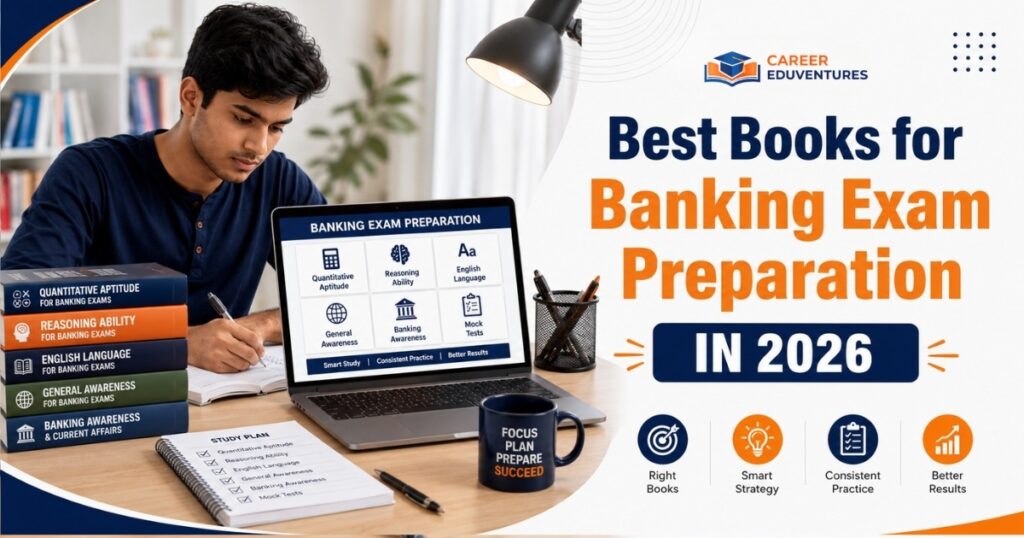
Banking exams test five fairly different skill sets – quantitative aptitude, reasoning, English, general awareness and computer knowledge. Expecting a single book to cover all of that properly is asking a lot, so this list of banking preparation books is organised by section.
Quantitative Aptitude
- Quantitative Aptitude for Competitive Examinations (R.S. Aggarwal) – still one of the most widely used books for this section. It builds concepts from the basics before moving into exam-level difficulty, which makes it a solid starting point for beginners and a reliable revision tool for repeat aspirants.
- Magical Book on Quicker Maths by M. Tyra – useful once the fundamentals are in place. It focuses on shortcuts and calculation speed, which matters a great deal in the time-bound prelims stage.
Reasoning Ability
- A Modern Approach to Verbal & Non-Verbal Reasoning by R.S. Aggarwal – covers puzzles, seating arrangements, syllogisms and coding-decoding with enough practice sets to build real speed.
- Analytical Reasoning by M.K. Pandey – often recommended alongside Aggarwal’s book for candidates who want deeper practice on higher-difficulty puzzle and arrangement questions, which tend to show up more in mains-level papers.
English Language
- Objective General English by S.P. Bakshi – a dependable option for grammar rules, error spotting and sentence correction, all presented with plenty of practice questions.
- High School English Grammar and Composition by Wren and Martin – less exam-specific but excellent for building genuine grammar fundamentals, particularly useful if English isn’t your strongest section.
- Word Power Made Easy by Norman Lewis – worth working through gradually for vocabulary building rather than last-minute cramming.
General and Banking Awareness
- Lucent’s General Knowledge – a long-standing favourite for static GK, covering history, geography, science and economics in a fairly digestible format.
- Banking Awareness by Arihant Experts or Disha Publications – both cover RBI monetary policy, banking terminology, financial institutions and current banking developments, which are heavily tested in mains papers.
- A current affairs monthly digest or newspaper habit (business sections of established publications) to keep the above banking study material relevant closer to exam day, since static books alone won’t cover the latest updates.
Computer Knowledge
- Lucent’s Computer – covers the fundamentals of computer awareness needed across most banking exams.
- Objective Computer Awareness for General Competitive Exams by Arihant – a good companion for additional practice questions in the same format as the actual exam.
Practice Sets and Previous Year Papers
Reading isn’t enough on its own. Topic-wise previous year question banks (Disha Publications and Adda247 both publish these regularly, updated for the current exam cycle) and full-length mock test series are what actually convert bank exam books into exam-day speed and accuracy.
A common mistake aspirants make while preparing for banking exam
A common mistake aspirants make is swapping books every few weeks, chasing the “perfect” one that never quite arrives. Instead of moving forward, they end up re-learning the same topics from five different authors. A better approach is to pick something reliable from the list above and commit to it. Good preparation books don’t just throw questions at you; they explain the concept first, then build difficulty gradually so you’re actually improving, not just guessing.
The same logic applies to study notes. Well-organised banking study material saves time because it follows a logical order rather than dumping everything on you at once. Preparation gets a lot easier once your resources stop changing every fortnight.
Why One Book Was Never Going to Be Enough
A question a lot of first-timers ask: can’t I just buy one comprehensive guide and be done with it? Not really. As the subject-wise list above shows, each section rewards a different kind of book – one that builds the concept, one that sharpens practice, and mock tests that build speed. Combined, they cover ground no single title among the available banking preparation books could realistically manage alone.
IBPS and SBI Aren't Quite the Same Exam
IBPS and SBI follow broadly similar patterns, but the details differ enough to matter. SBI tends to lean slightly more analytical, and SBI PO Mains includes a descriptive writing section that IBPS doesn’t require, so a separate descriptive English resource is worth adding if you’re sitting the SBI exam specifically. Around 90% of the core syllabus overlaps between IBPS, SBI and RBI, which is why the same best books for banking exams – R.S. Aggarwal for quant and reasoning, S.P. Bakshi for English – work across most of these exams, with only small additions needed for exam-specific quirks.
Aspirants targeting IBPS PO or Clerk should still pair these core titles with dedicated IBPS books that mirror that exact exam’s practice-question format, while those sitting the SBI exam benefit from adding SBI books that include descriptive writing practice, since that section doesn’t appear in the IBPS pattern.
Quality Beats Quantity, Every Time
Owning ten books doesn’t automatically improve your odds – if anything, it tends to create more confusion than clarity. A small, carefully chosen set of preparation books, like the ones listed above, usually beats constantly switching between authors and publishers.
Same goes for study material generally. Rather than downloading forty PDFs from random websites, stick to content that explains things properly, reflects the current exam pattern, and gives you enough to actually practise on. Consistency does more for you than variety ever will. This holds whether you’re working through IBPS books for the PO and Clerk exams or SBI books for SBI’s own recruitment cycle – a focused shelf beats a crowded one.
Reading Isn't Enough – You Have to Practise
Theory alone won’t get you through a competitive exam. You need to be solving questions regularly – it’s how you find your weak spots, learn to manage time under pressure, and walk in on exam day with some actual confidence. Mentors who’ve been through this repeatedly tend to say the same thing: balance the reading with problem-solving, don’t just do one.
Pairing solid bank exam books with daily mock tests builds a far more practical routine than reading chapter after chapter without testing yourself on any of it.
Don't Skip Revision and Mock Tests
Plenty of candidates spend months studying and almost no time revising, and it shows. Revision locks in what you’ve learned; mock tests show whether you can actually use it under exam conditions, and they’re brutally good at surfacing mistakes you didn’t know you were making. A solid routine includes weekly revision alongside full-length mock tests.
It’s not about clocking the most study hours. It’s about studying in a way that actually holds up when it counts. If you’d rather not build a mock test routine from scratch, head over to careereduventures.com, where Career Eduventure’s banking programmes include full-length mocks mapped to the current IBPS and SBI pattern, along with revision schedules that keep pace with your syllabus.
Build a Plan That Fits How You Actually Work
Everyone studies differently – early mornings work for some, late nights for others. There is no one-size-fits-all timetable, and trying to impose one seldom works. Consistency is the key. Have a realistic timetable covering all subjects, time for revision and regular practice tests, rather than trying to cram everything into one marathon session.
Small, steady progress beats a few days of intense studying followed by a long break, almost every time. It also makes the final weeks before the exam a lot less stressful. Our study programmes are built around exactly this kind of structured, subject-wise timetable, so you’re not left guessing how to divide your time across sections.
Stick to Resources You Can Actually Trust
There’s no shortage of content online – that’s both useful and a genuine problem. Plenty of free material floats around that doesn’t reflect the current exam pattern or explains things incorrectly. Bouncing between random videos, notes and PDFs tends to leave people more confused, not less.
Sticking with the trusted, widely-used banking study material titles listed above keeps preparation focused. It saves time, improves understanding, and means you’re spending more hours practising instead of hunting for the next resource.
Final Thoughts
Success in banking exams was never really about how many resources you collected – it’s about how well you used the ones you had. Choosing the best books for banking exams from a shortlist like this one, and sticking to trusted study material, consistent practice and proper revision, can genuinely make a difference to the outcome. Stick to your plan, understand the concepts rather than mugging up, and take regular mock tests to evaluate your progress.
Career Eduventures runs study programmes for banking aspirants based on the latest exam pattern, offering structured guidance and updated resources built around this same core reading list.
F.A.Q.
Frequently Asked Questions
For quant and reasoning, R.S. Aggarwal’s books remain the standard choice. For English, S.P. Bakshi’s Objective General English and Wren & Martin’s grammar guide are widely used. For general and banking awareness, Lucent’s General Knowledge alongside a dedicated Banking Awareness title from Arihant or Disha covers most of what’s tested. Pick a few from this shortlist you trust and go through them thoroughly – that consistency matters more than the number on the shelf.
Not really – there’s no magic number. Most people who clear these exams stick to one solid book per subject and revisit it repeatedly, pairing it with mock tests rather than hoarding books they never finish.
Not by much. IBPS-specific practice sets mirror that exact exam’s pattern, but the core books – R.S. Aggarwal, S.P. Bakshi, Lucent’s GK – work across IBPS, SBI and RBI exams because the syllabus overlaps heavily. Dedicated IBPS practice papers just help you get used to that specific format.
Self-study works fine for a lot of people, provided there’s actual discipline behind it – proper planning, regular revision, consistent mock tests. Plenty of successful candidates get there entirely on their own with a structured timetable, the right books and reliable resources.
Because SBI PO Mains adds a descriptive writing section that most IBPS-focused books don’t cover, and the question style in SBI papers has its own flavour. Practising with SBI-specific material and past papers gets you used to exactly that, rather than a generic approximation of it.